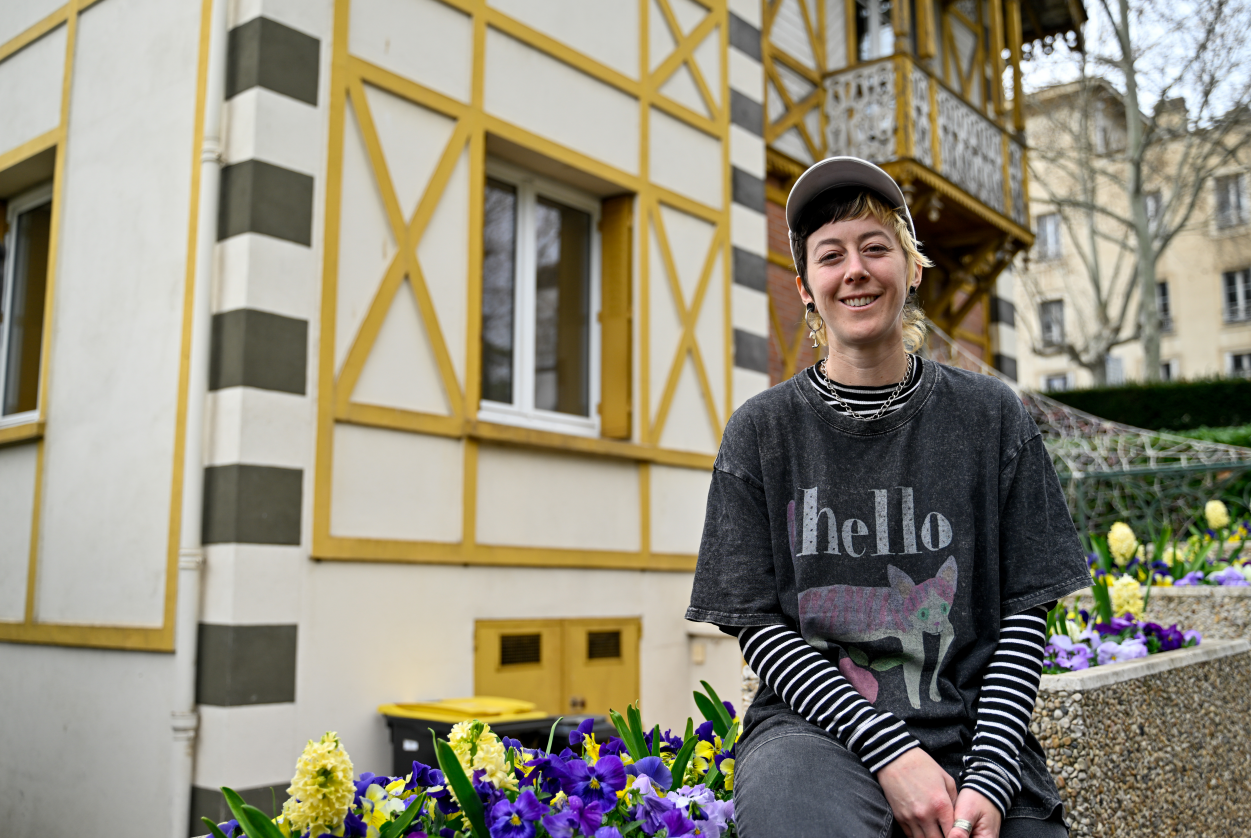
Kamil Duda (Salford, b. 2003) is a Polish multidisciplinary artist who grew up in Salford, United Kingdom, where he currently lives and works.
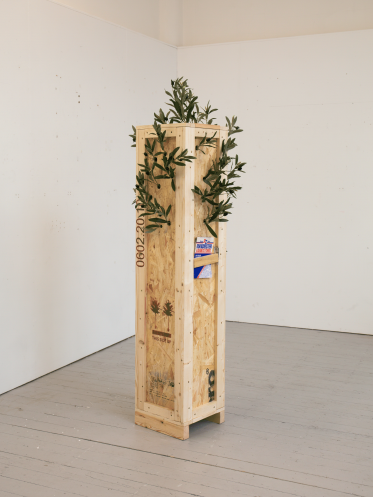
Olive Tree, 2026 © Kamil Duda
Kamil approaches art through the philosophies of care and radical critique, often adopting the role of a “ghost”: a figure through which he can address inequalities and imbalances in local and global contexts, as well as between the past, present, and possible futures. While sculpture forms the core of his practice, his physical and performative investigations are accompanied by a deep engagement with anarchist theory, critical writing, and site-responsive dialogue. Drawing on traditions of slapstick, sculptural performance, and productive failure, Kamil employs absurd actions as a means of exploring the limits of social, institutional, and material systems.
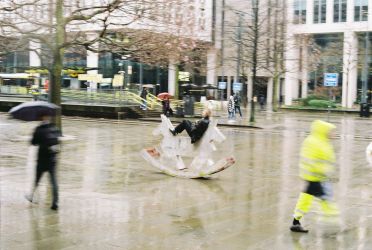
A+B, 2024 © Wren Adobe
During his residency in Regensburg, Kamil will use the twelve-ton granite eagle by Munich-based sculptor Albert Allmann as a case study for a series of sculptural and performative experiments, which he understands as a form of embodied field research. Originally commissioned for the Adolf Hitler Bridge, the sculpture remained enclosed in a wooden crate for twenty-five years. Following discussions regarding its destination, ownership, and historical significance, it was made publicly visible once again on 3 October 2026 in front of the Historical Museum.
Drawing on critical heritage studies, as well as broader debates surrounding monumentality and the political dimensions of public sculpture, Kamil will investigate how sculptural processes such as enclosure, positioning, relocation, and acts of making visible can shape our engagement with “difficult heritage,” a term coined by Sharon Macdonald (2006).
Through material and spatial experiments, Kmil will examine how a sculpture’s physical presence, scale, location, and visibility influence the ways it is perceived, interpreted, and responded to. Combined with performance and a series of gestures, the sculpture becomes both the subject and the method of inquiry.
Kamil intends to use his stay in Regensburg to explore how decisions regarding the preservation and presentation of historical artefacts associated with a difficult past generate meaning in the present. The project will also address the role of the artist within heritage politics and consider how history is materialized, situated, and experienced.