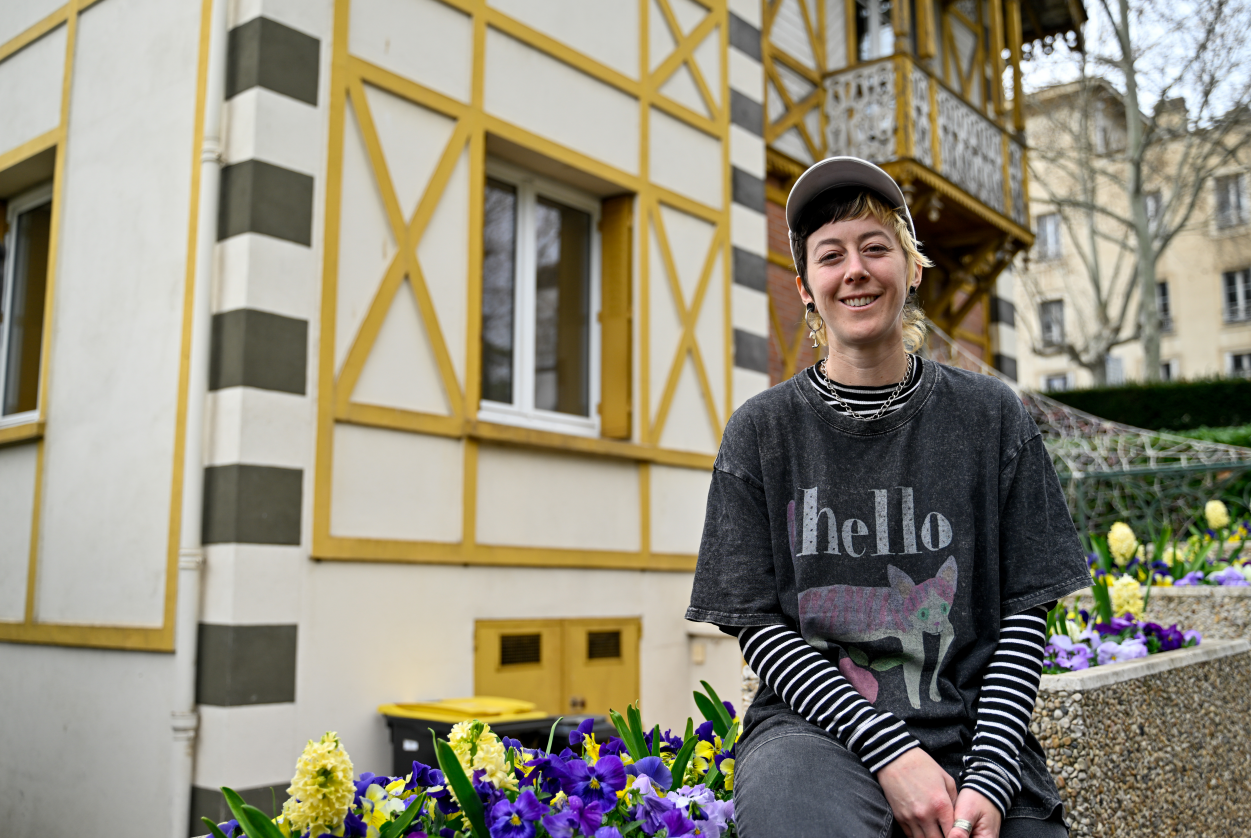
Cristina de Pedrojuán Pascual (Aranda de Duero, Spain, 1997) is a Spanish artist currently living and working in Milan, Italy. After graduating from the School of Fine Arts in Salamanca, she moved to Milan, where she completed a Master’s degree in Visual Arts, specializing in Painting, at the Brera Academy of Fine Arts in 2023.
Alongside her artistic practice, she has worked as an assistant to internationally renowned artists, including Gabriel Chaile and Andreas Zampella, gaining extensive experience in the production and development of contemporary art projects. Her work has also been presented in solo and group exhibitions in Spain, Italy, and Germany.
Her artistic practice explores the relationship between physical and virtual space, with a particular interest in playgrounds as sites of play, interaction, and social encounter. Cristina is interested in how these spaces shape their own landscapes through the activities that take place within them, and in how their physical structures can be understood through the experiences and relationships they make possible.
During her residency in Regensburg, the artist intends to focus her research on the city’s playgrounds. Drawing on their digital representations, she will analyze their forms, structures, and spatial relationships. Within this framework, she will create a digital environment composed of several playgrounds in Regensburg. From these virtual environments, she will extract selected elements and spatial structures, which she will then translate into the physical world using plastic mesh.
The resulting work will not constitute a faithful reconstruction of the observed playgrounds, but rather a fragmented transposition of their spatial logic from one medium to another.
This transition from the physical playground to its digital representation, and then to a material installation, will allow the artist to examine the distance between the way a space exists, the way it is represented, and the way we perceive it.
Through this project, Cristina aims to consider the playground as a space that exists simultaneously as a physical structure, a site of human interaction, and a potential virtual environment. Digital technology is not conceived merely as a tool of representation, but as a medium through which physical space can be observed, transformed, and reimagined.